Accepting new engagements

Independent model audits and quant research for investment teams.

We review and build forecasting, backtesting, and risk models that can be reproduced, challenged, and explained when a decision depends on them.

  • Econometrics · ML · Governance
  • New York · Operating globally
  • NDA by default · Reproducible
  • NDA by default · Reproducible · New York

01section What we solve

The problems that put capital and credibility at risk.

Most engagements start with a model or result someone needs to trust before they act on it.

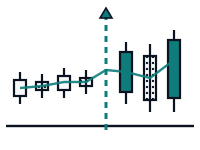
Backtest leakage

A backtest that looks too good

The numbers are strong, but you cannot tell whether the result is signal or future information leaked into the test.

We reproduce the backtest from point-in-time data and trace every input before capital is at risk.

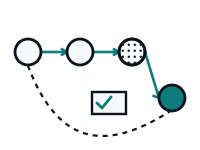
Regime shifts

A model that breaks when the market changes

The model worked in one regime and quietly fails when volatility, correlations, or market structure change.

We stress the model across regimes so you know how it behaves when conditions turn.

Model governance

A model you cannot put in front of oversight

The model drives decisions, but assumptions, validation, and limitations are not documented in a form reviewers can inspect.

We produce methodology, validation, limitations, and reproducible code so the reasoning travels with the result.

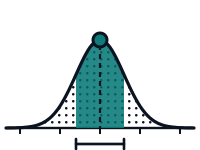
Forecasting uncertainty

A forecast with no honest error bars

The forecast is a point estimate with no honest view of how wrong it could be.

We deliver calibrated uncertainty, validated out-of-sample, so decisions account for a range of outcomes.

02section Engagements

Four ways to get the model work reviewed, built, or taught.

Choose the engagement that matches the decision in front of your team. Scope, fee, timeline, and deliverables are agreed in writing before work starts.

04. Start with the risk, the decision, and the evidence your reviewers need. Then we choose the smallest engagement that can answer it.

E.01

Model & Backtest Audit

An outside technical review of a strategy or model before you size it up: leakage, fragile assumptions, and results that will not reproduce.

For
Teams about to allocate to a strategy, hand a model to an investment committee, or inherit a backtest they did not write and cannot fully trust.
Timeline
Two to four weeks, scoped to the complexity of the codebase and data.
Deliverables
  • A reproduction of your backtest from raw data, with every assumption made explicit.
  • A leakage and look-ahead review of data alignment, point-in-time correctness, and survivorship.
  • A findings memo: what holds, what does not, and what we could not verify.
  • A prioritized remediation list, ranked by impact on the result.
  • The full review as a reproducible notebook your team keeps.

OutcomeYou learn whether the result is real before capital depends on it, with a documented technical findings memo you can put in front of an IC or a risk committee.

E.02

Forecasting & Risk Model Build

A forecasting or risk model built from your data, validated out-of-sample, and delivered with uncertainty stated, not hidden.

For
Investment and data teams that need a defensible forecast, a VaR or Expected Shortfall model, or a probabilistic estimate they can stand behind under review.
Timeline
Four to ten weeks, depending on data readiness and model scope.
Deliverables
  • A model fit with methods chosen for the problem: time-series, state-space, Bayesian, or disciplined ML, not a default.
  • Out-of-sample and walk-forward validation, with the evaluation method documented.
  • Calibrated uncertainty: intervals or distributions, not single-point answers.
  • A methodology memo covering assumptions, limitations, and known failure modes.
  • Production-ready code and notebooks, with a path to monitoring.

OutcomeYou get a model whose behavior you understand and can explain, including where it is weak, instead of a black box you have to take on faith.

E.03

ML Infrastructure Review

A review of the pipelines, data flow, and deployment around your models so the system is reproducible, monitored, and ready for audit.

For
Teams running models in production who need governance, reproducibility, and monitoring to hold up to a risk committee or technical reviewer.
Timeline
Three to six weeks, scoped to the size of the stack.
Deliverables
  • A map of your data and model pipeline, from source to decision, with failure points marked.
  • A reproducibility and versioning review: can a result be regenerated, and is it tracked.
  • A monitoring and drift assessment: what is watched, and what should be.
  • A model-governance gap analysis against review and audit needs.
  • A prioritized remediation plan, sequenced by risk.

OutcomeYou move from a model that works on someone's machine to a documented, reproducible, monitored system you can defend to oversight.

E.04

Private Quant Training Cohort

Practitioner-led training for your team, built around your stack and the problems you actually face, not a generic course.

For
Investment and data teams that want to raise their bar on econometrics, validation, and model governance, taught by someone who does the work.
Timeline
Scoped as a multi-week cohort, set by curriculum depth and team size.
Deliverables
  • A curriculum designed to your team's level and objectives, agreed before we start.
  • Live, practitioner-led sessions with worked examples on realistic problems.
  • Hands-on exercises and reproducible notebooks your team keeps.
  • Coverage of the failure modes that matter: leakage, regime shifts, validation, and uncertainty.
  • A reference set your team can return to after the cohort ends.

OutcomeYour team leaves able to spot the mistakes that sink models and build or review work to a higher standard on their own.

03section Process

How an engagement runs.

Four steps, with a deliverable at each one. You always know what you are getting and when.

S.01

Scoping

We define the problem, the data you have, the decision it feeds, and what defensible has to mean for your IC, risk committee, or technical reviewer. We agree on scope, constraints, and success criteria before any work begins.

You receiveA written scope and engagement plan: objectives, data and access requirements, milestones, and a fixed or scoped fee.

S.02

Audit / Research

We examine what exists: the model, the backtest, the assumptions, or the research the build depends on. We surface failure modes early: leakage, look-ahead, regime sensitivity, and the gap between in-sample fit and a live decision.

You receiveA findings memo covering what holds, what does not, the methods we tested, and a ranked list of issues with recommended fixes.

S.03

Build

We implement the model, pipeline, or fix in code, with validation built in rather than added after. Every result is reproducible from data lineage to output, and reviewed against the criteria set in scoping.

You receiveReproducible code and notebooks, a validation report, and the model or system itself, documented for review.

S.04

Handoff

We hand the work to your team so it runs without us, walking through the code, the assumptions, the monitoring, and the limits. The goal is that your people can defend, maintain, and extend it.

You receiveHandoff documentation, a walkthrough session, and where applicable a monitoring plan and the artifacts needed for governance or audit review.

04section Proof

Inspection-ready by default.

Every engagement is built to be inspected: reproducible notebooks, methodology memos, validation reports, and handoff documentation. Where client work is confidential, we show the standard through redacted examples and synthetic-data artifacts.

What every engagement produces

Reproducible notebooks

Code and notebooks that regenerate every result from raw data to output, with no manual steps or unexplained numbers.

Methodology memo

A written account of the methods, assumptions, and choices behind the work, so the reasoning travels with the result.

Validation / model-risk report

Out-of-sample tests, leakage and look-ahead checks, and known limitations, written for a reviewer and not just for us.

Handoff documentation

The setup, structure, and operating notes your team needs to run, maintain, and extend the work without us.

Monitoring plan

Where a model goes to production: what to watch, what should trigger review, and how to tell when it has drifted. Provided where applicable.

Representative engagements

Representative · illustrative scope

Model & backtest audit. A quant or PM team about to allocate to a strategy whose backtest looks strong. Outside technical review of the strategy's data handling, backtest construction, and assumptions, checking for leakage, look-ahead, survivorship, and overfitting before capital is committed.

Representative · illustrative scope

Forecasting & risk model build. An investment or fintech team that needs forecasts with honest uncertainty around them. Building a probabilistic forecast, scenario design, or VaR / Expected Shortfall model, with validation and documentation built for review.

Representative · illustrative scope

ML infrastructure review. A data-driven team whose models work in research but are hard to trust in production. Review of the pipeline that feeds and serves models across lineage, features, evaluation, deployment, and monitoring to find where results can silently degrade.

See public synthetic-data artifacts that show the deliverable standard without exposing client information. Engagement details and references are held under NDA; we do not publish client names, data, or results without written permission.

05section Education

Practitioner-led training in the methods we use.

We teach the same econometrics, statistics, and machine learning we apply in engagements: math-first where it matters, hands-on throughout. The work runs through the Private Quant Training Cohort; the areas below are the ground it covers.

  • Econometrics & Statistics: time-series, panel, and causal inference; forecast evaluation and risk metrics.
  • ML Foundations: linear models through deep learning, with intuition for when each earns its place.
  • Data Science: reproducible pipelines in Python and R; ML and MLOps fundamentals.
  • Programming: R, Python, SQL; testing, structure, and reproducibility from the start.
  • Game Theory & Market Design: strategic interaction, mechanism design, and auctions for real markets.
  • Custom Workshops: private cohorts and curriculum scoped to your team.

06section AI & Data Engineering

Production systems for data and models, held to an institutional standard.

The infrastructure that carries research into production: data pipelines, feature stores, and the deployment, monitoring, and evaluation that keep models accountable. Engineered for reproducibility and audit, with on-chain data and settlement only where a client genuinely needs it.

B.01

ML & Data Infrastructure

Streaming and batch pipelines, feature stores, and reproducible training and deployment. Versioned data and models, evaluation gates, and monitoring keep production tied to what was validated.

Pipelines Feature Stores Monitoring
B.02

Applied AI Systems

Model integration, retrieval, and evaluation pipelines built for production use, measured against task-specific metrics, monitored in operation, and accountable when they drift.

Retrieval Evaluation Production
B.03

On-Chain Data & Smart Contracts

For clients who need it: ingestion and analysis of on-chain data, and security-first smart-contract work with auditable, upgrade-aware patterns. Offered on request, not as a headline.

On-Chain Data Auditable On Request

07section Built by StatGazer

Products with the same bias toward restraint.

Alongside client work, StatGazer builds small software products where privacy, clarity, and long-term use matter more than attention mechanics.

iPhone app

GoodUp

GoodUp is a private iPhone app for keeping a quiet rhythm of giving, care, promises kept, and weekly reflection.

No accounts On-device data No ads No analytics

Product principle

The app keeps its surface calm: no public profile, no leaderboard, and no streak pressure around acts of care.

Learn about GoodUp

08section Founder

Founder: Evgenii Azarov

Evgenii Azarov, founder of StatGazer

Evgenii Azarov

Data Scientist · Financial Engineer · Educator

Econometrics · Statistics Machine Learning Financial Engineering PhD in Law · 2012 20 years private teaching Software & iOS Engineering New York, United States Direct founder delivery

StatGazer was founded by Evgenii Azarov, a data scientist and financial engineer with a PhD in Law, finance training at NYU, and 20 years of private teaching and consulting for family offices, investment teams, and researchers. The firm is intentionally founder-led: scoping, technical review, model work, and handoff are handled directly rather than passed through a bench of junior staff. Public synthetic artifacts are available below so prospective clients can inspect the working standard before sharing confidential data. See the founder page for the full credibility ledger.

Reach the founder directly at hello@statgazer.com.

Entity

StatGazer LLC · Registered in New York, United States · Operating globally.

Vendor / KYC

Use hello@statgazer.com for onboarding, NDA routing, tax forms, and procurement details. E&O coverage is addressed during onboarding; raise specific requirements before paid work begins.

Data handling

NDA-first, minimal extracts where possible, encrypted provider infrastructure, founder-only access unless agreed otherwise, and no third-party AI training.

Professional boundary

Technical model review, validation, research, and engineering consulting — not financial-statement audit, regulatory assurance, investment, legal, or tax advice.

09section FAQ

Security, IP, and the practical questions.

How does an engagement work?

Every engagement starts with a scoping call, then a written scope and fee before any work begins. From there we run four steps: scoping, review or research, build, and handoff. You receive a deliverable at each one. Most engagements are scoped as a fixed piece of work; longer or embedded research runs on an agreed cadence.

How is our data handled, and will you sign an NDA?

Yes. We sign an NDA before reviewing confidential data, and we are glad to work under yours. Where possible we work inside your environment or on a minimal extract, retain only what the engagement needs, and return or delete data on request at the end. Access is limited to the founder unless otherwise agreed in writing. We do not use client data for third-party AI training.

Is this a financial audit or regulatory assurance service?

No. StatGazer provides technical model review, validation, research, and engineering consulting. It is not a CPA firm, public accounting firm, broker-dealer, investment adviser, or regulatory assurance provider, and its deliverables are not financial-statement audit opinions or regulatory assurance reports.

Who owns the deliverables and the IP?

You own the deliverables produced for your engagement: the code, models, notebooks, and reports. We retain our pre-existing methods, tooling, and general know-how. Specific ownership and license terms are set in the engagement agreement so there is no ambiguity later.

How does pricing work?

Pricing is scoped per engagement. After the scoping call we send a written scope with a fixed fee where the work is well-defined, or a clear rate and estimate where it is open-ended. We do not quote a price before we understand the problem, and we do not bill for work outside an agreed scope without agreeing it first.

What is your typical response and turnaround time?

We reply to enquiries within 24 hours. Turnaround on the work itself depends on scope and is agreed in writing before we start; we would rather commit to a date we can hold than to one that sounds fast.

Why use an outside reviewer instead of our own team?

An outside reviewer gives the internal champion a defensible second read: leakage checks, reproducibility, assumptions, and limitations documented by someone who did not build the original model. Your team keeps ownership and context; StatGazer adds a technical review record that can travel to an IC, risk committee, or vendor review.

How does this fit with internal MRM or Big Four work?

Use internal MRM when your organization needs ownership, policy enforcement, and recurring controls. Use a Big Four or regulated assurance provider when procurement requires a large assurance firm, attestation, or a formal enterprise program. Use StatGazer when the gap is focused technical evidence: reproduction, leakage checks, validation design, and a findings memo your team can inspect.

What happens if the founder is unavailable during an engagement?

Engagements are scoped in increments, with written artifacts delivered as work progresses. The client owns the deliverables produced for the engagement. If founder availability changes materially, we pause new work, hand over completed artifacts, and agree the next step in writing rather than silently substituting junior delivery.

What if the review finds nothing material?

That can be a useful outcome. The memo still documents what was checked, what evidence supported the result, what limitations remain, and what monitoring or follow-up is sensible. We do not manufacture findings to justify the engagement.

What is your cancellation and refund approach for paid training?

For scheduled training, you can cancel or reschedule up to ten business days before the start date for a full refund or credit; after that, fees may be partly retained to cover reserved time. For self-paced access, terms are stated at the point of purchase. Full terms are in the Refund Policy.


10section Contact

Start with a scoping call.

Bring us a model, a backtest, or a forecasting problem you need to defend. We will tell you the shortest honest path to a result you can stand behind and whether we are the right team for it.

We reply within 24 hours · Direct line hello@statgazer.com

What happens on the scoping call

  • We map the problem, the data, and where the current approach is exposed.
  • We outline an engagement: scope, deliverables, and a timeline range.
  • You leave with a clear next step, whether or not you work with us.

Training & courses

A separate track from consulting. If you want a paid program such as the training cohort, request access and we will send current terms before enrollment.

Request program access
Request a scoping call